
A clearer way to understand how each process section shapes cement production.
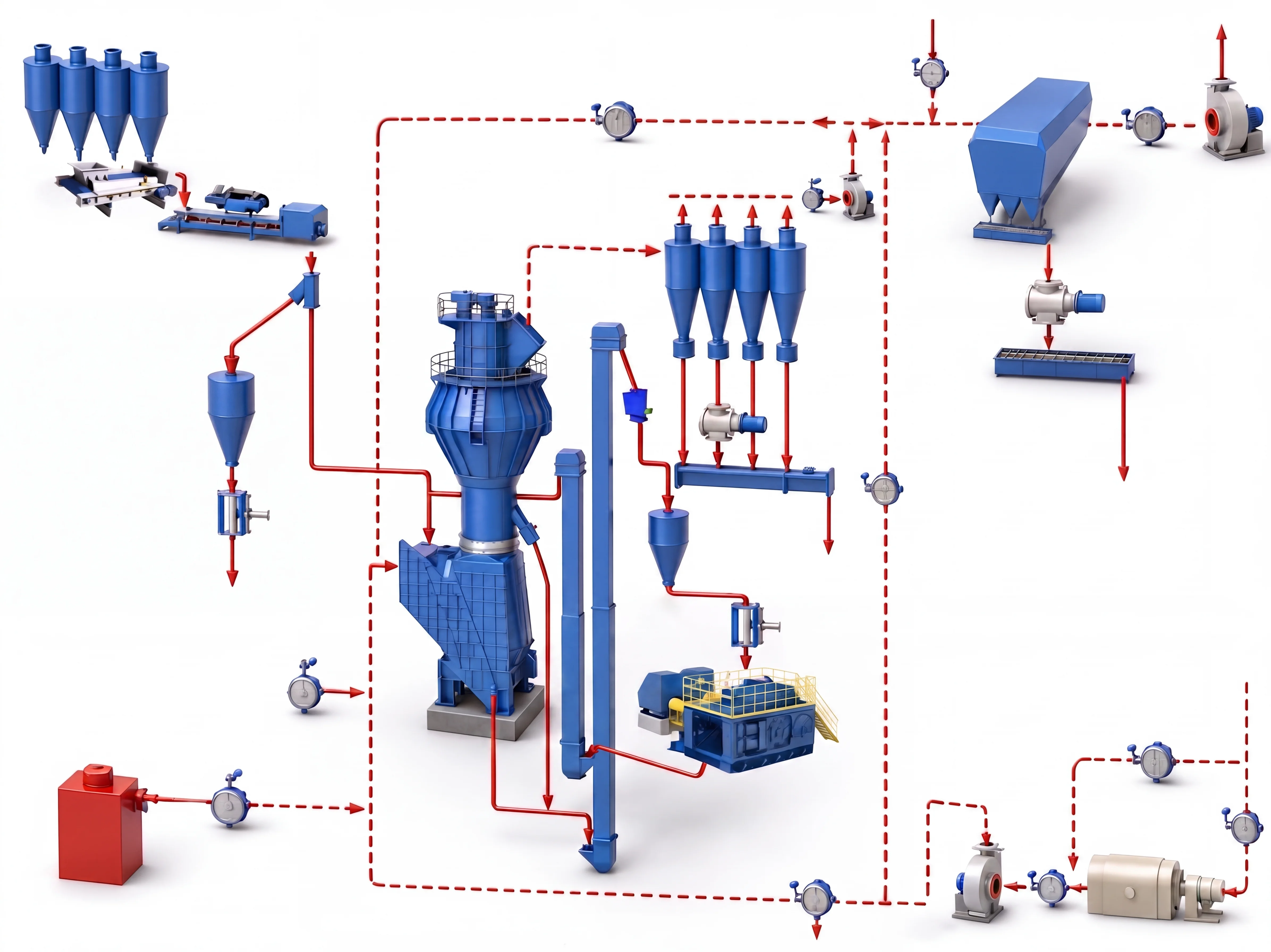
Raw Material Grinding System
Raw meal grinding systems are selected according to raw material moisture, grindability, and capacity targets. Vertical roller mill or roller press systems are recommended over ball mill systems, with a three-fan process using cyclones, high-temperature fan, circulating fan, and waste gas treatment fan.
Core advantages
- System power consumption: 10–11 kWh/t with roller press
- System power consumption: 13–14 kWh/t with vertical roller mill
- Product fineness: R80 μm < 12%
- Product fineness: R200 μm < 2%
- Matched to moisture, grindability, and capacity targets
Application Scenarios
- Cement plant raw meal preparation
- Raw grinding capacity upgrades
- High-moisture raw material conditions
Delivery Scope
- Overall solution
- Process and multi-discipline engineering design
- Packaged equipment supply
- Installation and commissioning
- Production ramp-up and compliance
- O&M support, selected by project
Useful inputs
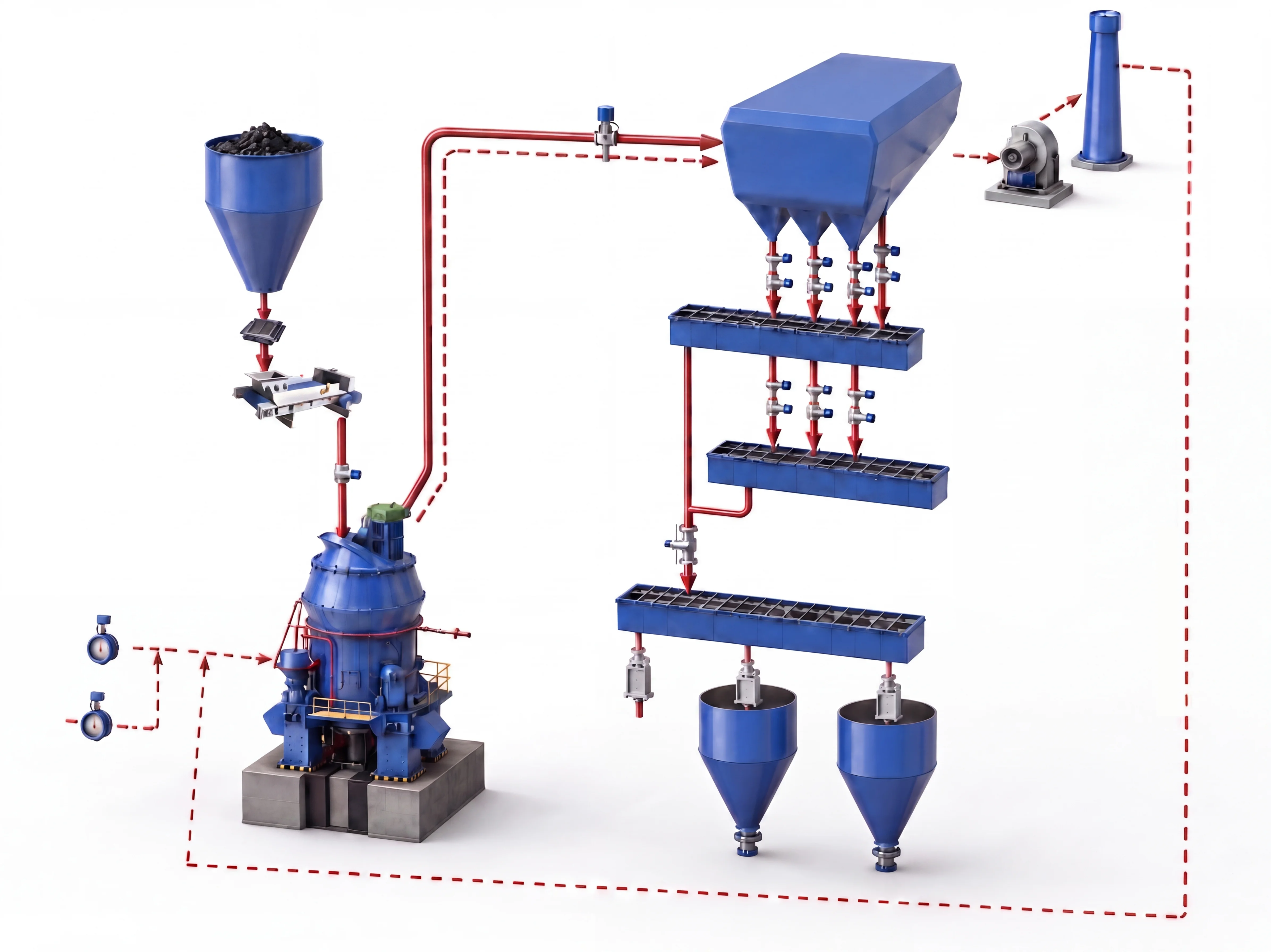
Coal Grinding System
Pulverized coal preparation in cement plants usually adopts either a roller mill system or a ball mill system. Since the 1980s, bed grinding technology has improved rapidly, and vertical mills and roller presses have become important alternatives to traditional ball mill grinding.
PROCESS AND RECOMMENDATIONS
Vertical Mill System
A roller mill grinds material based on bed grinding principles, using the relative movement between grinding rollers and the grinding table. It integrates crushing, grinding, drying, and classification, simplifying the process. It accepts relatively large feed size, up to 4%–5% of roller diameter, and can introduce large volumes of hot air, making it suitable for high-moisture bituminous coal and lignite.
Ball Mill System
Ball mills have long been used for fine grinding. Drying-and-grinding ball mill systems crush and dry material at the same time, with fast heat exchange because material is dispersed in hot gas flow. Drying methods include internal drying, external drying, and combined internal and external drying. Ball mill systems are stable and easy to maintain, but have lower grinding efficiency and higher power consumption.
Recommendation
For pulverized coal preparation, vertical mill systems are preferred because of stronger drying capacity and higher grinding efficiency. Air-swept ball mills can also be used for broader coal adaptability, preferably with a drying chamber plus a single grinding chamber.
Application Scenarios
- New pulverized coal preparation systems
- Coal grinding capacity upgrade projects
Delivery Scope
- overall solution
- process and multi-discipline engineering design
- packaged equipment supply
- installation and commissioning
- production ramp-up and compliance
- O&M support, selected by project.
Useful inputs
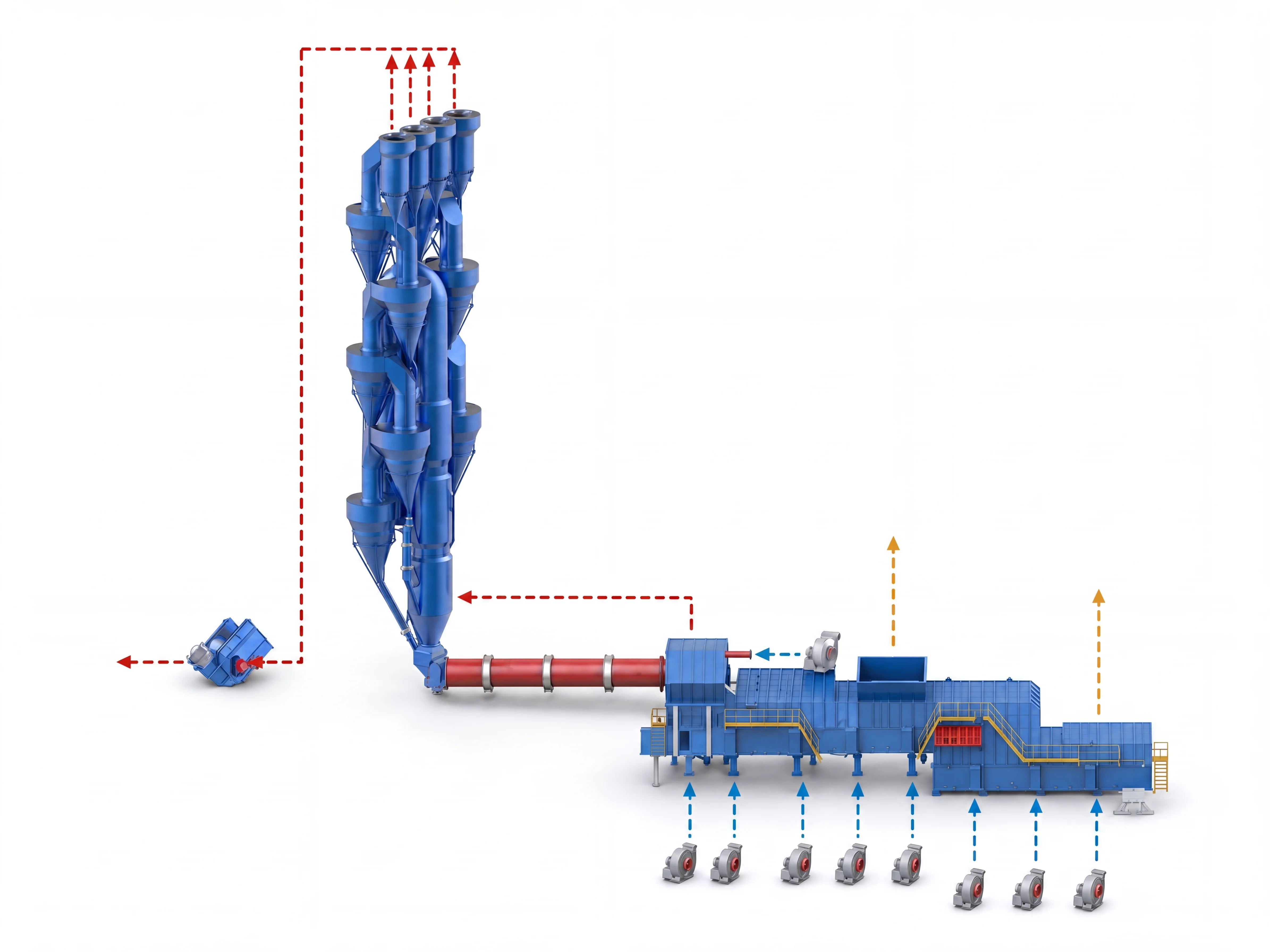
Pyroprocessing System
The cement clinker pyroprocessing system serves as the core section of a modern dry-process cement production line. It calcines preheated and decomposed raw meal into clinker under high temperatures, with a classic process consisting of suspension preheating, precalcination, rotary kiln calcination and clinker cooling via grate cooler.
Line composition
- Preheating and Precalcination System
- Rotary Kiln Calcination System
- Clinker Cooling System
- Hot Air Piping System
- Pulverized Coal Combustion System
- Thermal Automatic Control & Safety Interlock System
- Exhaust Gas Treatment and Auxiliary System
Core advantages
Feed decomposition rate into kiln ≥94%
C1 outlet temperature ≤ 300℃
Clinker thermal consumption: approx. 690–720 kcal/kg clinker
Clinker temperature at grate cooler outlet: ≤ 65℃ + ambient temperature; Secondary air temperature ≥ 1150℃
Power consumption of pyroprocessing system: 20~25 kWh/t clinker
Applicable scenarios
Suitable for new-build complete firing system matching, energy-saving technical renovation of existing production lines and capacity expansion upgrading. Firing system retrofitted for co-firing of alternative fuels including domestic waste-derived RDF, industrial hazardous waste, sludge and steel slag, complying with relevant environmental co-disposal policies.
Delivery scope
Process formulation, heat balance calculation & analysis, equipment type-selection proposal, equipment supply, equipment optimization & retrofitting, automatic control system optimization, and technical commissioning support for production ramp-up to rated capacity.
Useful inputs
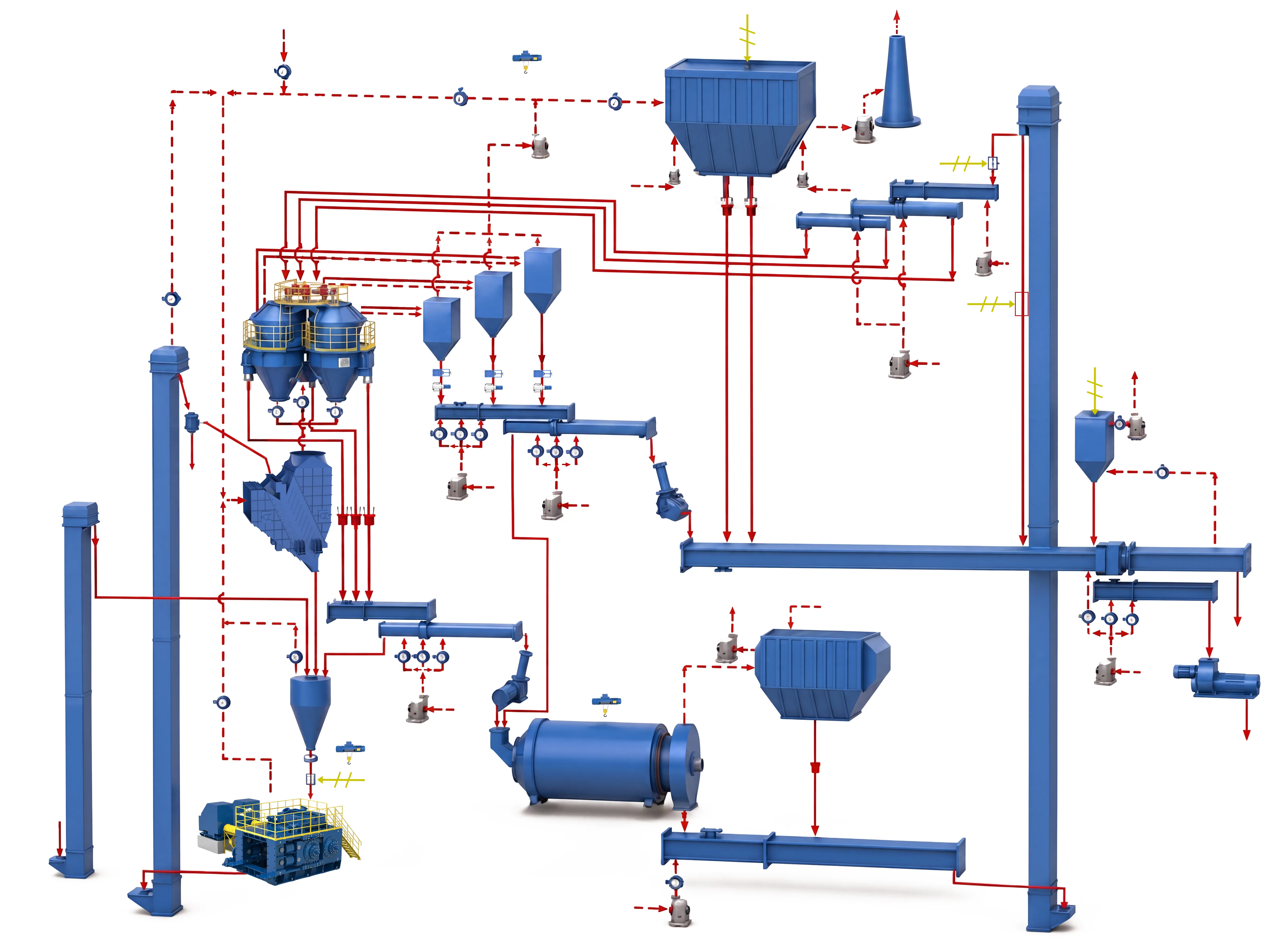
Cement Grinding System
Traditional cement grinding mainly used ball mills. Since the 1980s, bed comminution technologies such as vertical roller mills and roller presses have become major alternatives. According to the main equipment and process route, cement grinding systems can be divided into ball mill systems, pre-grinding systems, and finish grinding systems.
PROCESS AND RECOMMENDATIONS
Performance Data
- System power consumption: <26 kWh/t with roller press + ball mill
- System power consumption: <23 kWh/t with roller press finish grinding
- System power consumption: 24–25 kWh/t with vertical roller mill finish grinding
- Product fineness: 3400–3600 cm²/g @P・O 42.5
Ball Mill System
Pre-Grinding System
Circulating Pre-Grinding System
Combined Grinding System
Semi-Finish Grinding System
System Recommendation
Application Scenarios
- New cement grinding station projects
- Existing cement grinding system upgrade projects
- Environmental and automation system integration projects
Delivery Scope
- Overall solution
- Process and multi-discipline engineering design
- Packaged equipment supply
- Installation and commissioning
- Production ramp-up and compliance
- O&M support, selected by project
Useful inputs
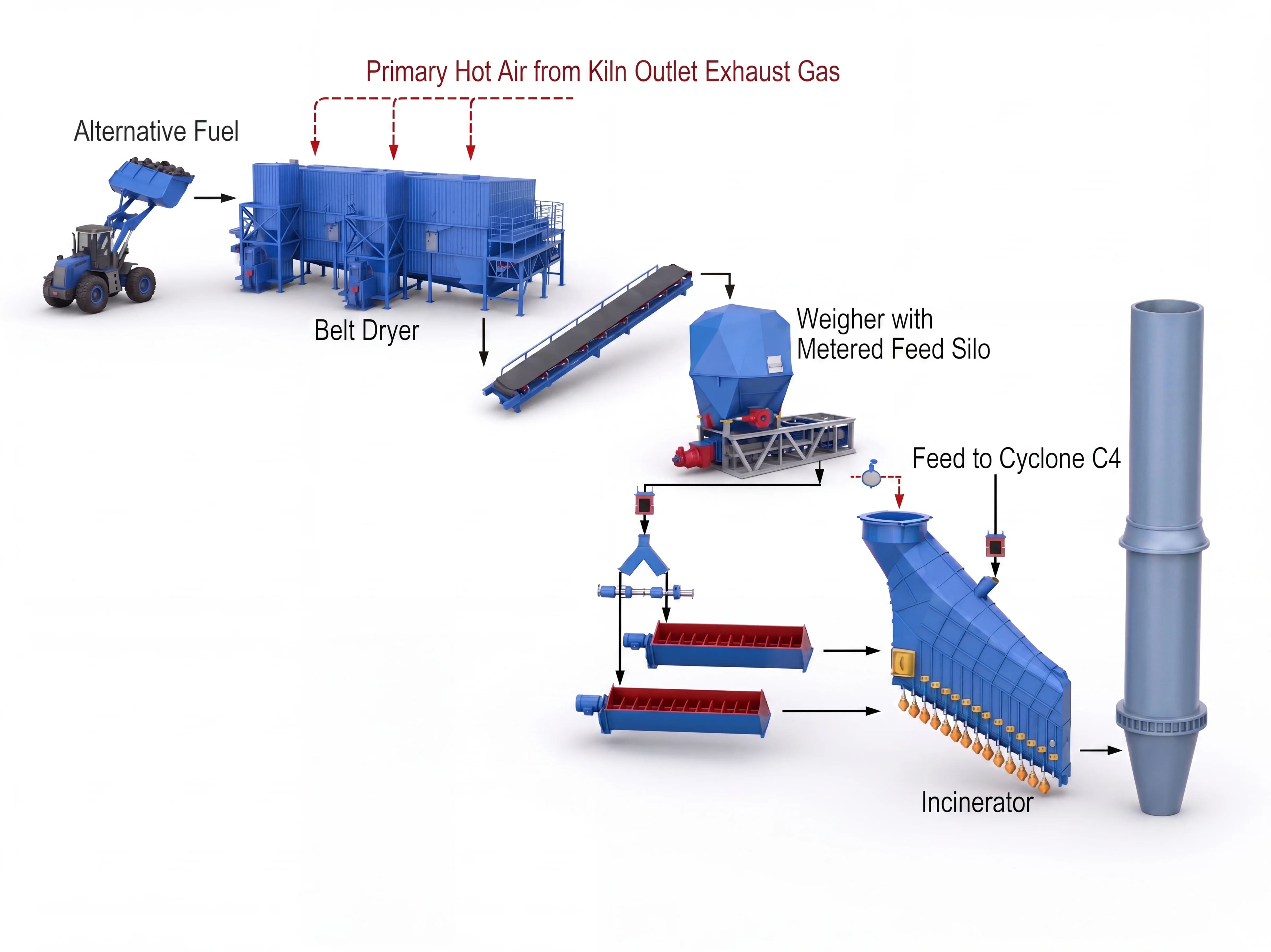
Alternative Fuel System
The alternative fuel system covers receiving, storage, pre-treatment, conveying, metering and kiln feeding of raw feedstock, enabling high-ratio substitution of conventional fossil fuels while securing stable kiln operation.
Line composition
- Raw Material Receiving & Storage System
- Pre-treatment & Preparation System
- Closed Conveying & Precision Metering System
- Multi-point Kiln Feeding & Combustion System
- Auxiliary Environmental Protection, Thermal Optimization & Automatic Control System
Core advantages
Wide applicable range of feed materials
High metering accuracy
Stable operation with high intelligence level
Residence time of alternative fuels inside the stepped calciner is controllable for complete burnout.
Applicable scenarios
Applicable for new plant matching, energy-saving retrofit of existing lines, capacity expansion and industrial park co-disposal, in compliance with environmental co-processing policies as well as energy conservation and carbon reduction requirements.
Delivery scope
Process formulation, heat balance calculation & analysis, equipment type-selection proposal, equipment supply, equipment optimization & retrofitting, automatic control system optimization, and technical commissioning support for production ramp-up to rated capacity.
Useful inputs
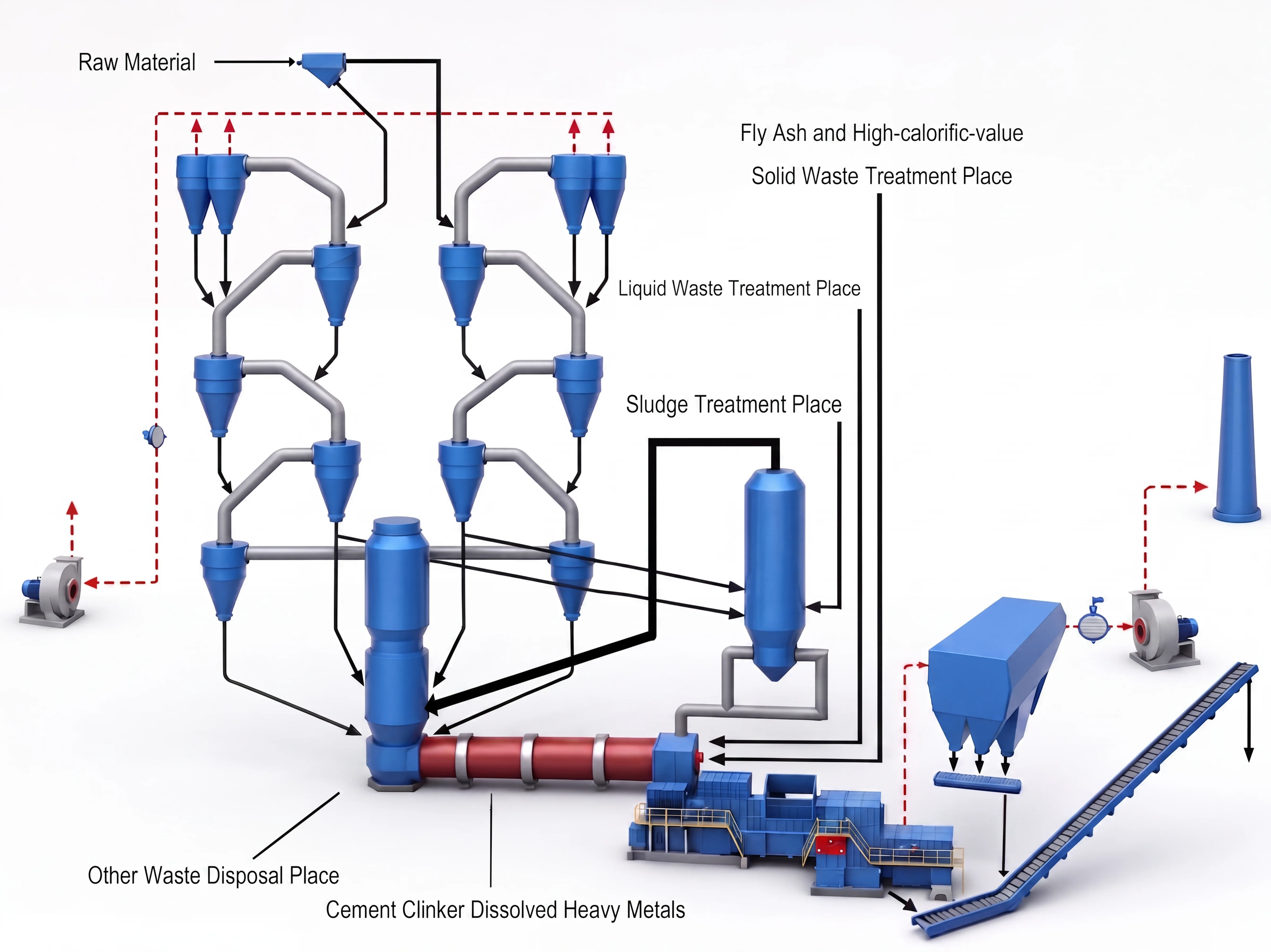
Co-processing System
The cement kiln co-processing system consists of material receiving, storage, pre-treatment, closed conveying, precise metering, targeted feeding into stepped calciner and differentiated feeding at multiple positions (calciner/kiln hood), equipped with an intelligent control system to balance high fuel substitution rate and stable kiln production.
Line composition
- Raw Material Receiving & Storage System
- Pre-treatment & Preparation System
- Closed Conveying & Precision Metering System
- Multi-point Kiln Feeding & Combustion System
- Auxiliary Environmental Protection, Thermal Optimization & Automatic Control System
Core advantages
Built upon existing kiln lines, the capital investment is substantially lower than constructing a standalone incineration plant.
Solid waste achieves thorough harmless treatment with no secondary solid waste residues generated.
Capable of treating a wide range of solid wastes with abundant market feedstock supply.
Full-process DCS automatic control features high metering accuracy, stable operation and low manual maintenance cost.
Applicable scenarios
Support for new clinker production lines, energy-saving renovation of existing cement lines, supporting modification for clinker line capacity expansion, and centralized solid waste co-disposal projects for industrial parks.
Delivery scope
Process formulation, heat balance calculation & analysis, equipment type-selection proposal, equipment supply, equipment optimization & retrofitting, automatic control system optimization, and technical commissioning support for production ramp-up to rated capacity.
Useful inputs
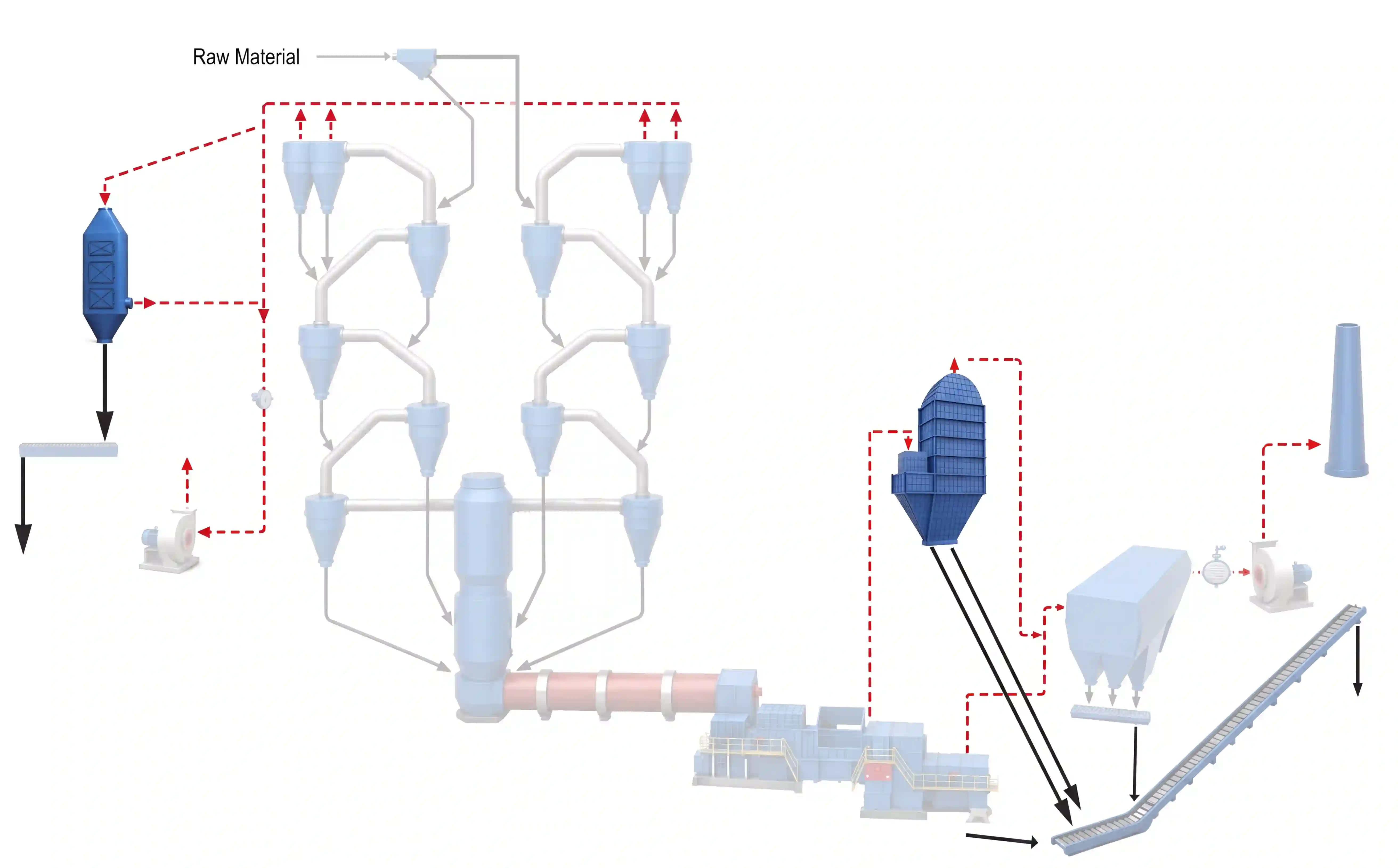
Waste Heat Recovery System
Waste heat recovery system recovering cooler and preheater exhaust heat to improve energy cascade utilization and reduce purchased power dependence.
Line composition
- SP Waste Heat Boiler System at Kiln Back-End
- AQC Waste Heat Boiler System at Kiln Outlet
- Steam & Condensate Circulation System
- Flue Duct, Damper & Automatic Control System
Core advantages
Zero fuel consumption with pure waste heat resource utilization.
Reduce the power consumption cost of cement plant and increase the on-site self-power supply ratio.
Optimize kiln system operating conditions to save energy and reduce consumption.
Low-carbon and eco-friendly, compatible with dual-carbon goals and ultra-low emission standards.
High cost-performance for renovation with short payback period of investment.
Multi-functional coupling to match co-processing requirements.
Applicable scenarios
Supporting construction for new clinker lines, energy-saving retrofitting of old cement production lines, optimization after firing system upgrading, and matching modification for solid waste co-processing projects.
Delivery scope
Process formulation, heat balance calculation & analysis, equipment type-selection proposal, equipment supply, equipment optimization & retrofitting, automatic control system optimization, and technical commissioning support for production ramp-up to rated capacity.
Useful inputs
Air Pollution Control
Air Pollution Control is deeply coupled with clinker burning process, adaptable to hazardous waste and solid waste co-processing in cement kilns with auxiliary facilities for synergistic removal of dioxins and heavy metals, shifting environmental governance from terminal treatment to full-process control covering source, process and terminal links.
Denitrification System
The denitrification system for cement clinker production lines consists of low-NOₓ burner technology, staged combustion technology, SNCR and SCR processes to guarantee NOₓ emissions comply with statutory standards.
Core Advantages
- Optimal solutions available based on actual production conditions and emission limits.
- Each system module can run independently or in coordinated operation.
- Proven source reduction technologies with low capital cost and no secondary pollution risks.
- Capable of ultra-low emission control down to ≤50 mg/Nm³.
System Composition
- Low-nitrogen burners
- Precalciner staged combustion equipment
- Ammonia water storage and injection system
- Intelligent control system
- Denitrification reactor and catalysts
Desulfurization System
Three desulfurization routes (dry, semi-dry and wet processes) are applicable for clinker production, with customized selection against practical demands.
Core Advantages
- Tailored optimal solutions for varied working conditions and emission requirements.
- Dry desulfurization features minimum investment, easy retrofitting and zero waste discharge.
- Wet desulfurization achieves over 98% removal efficiency, with by-product gypsum marketable for sales.
- Semi-dry desulfurization delivers excellent desulfurization performance without waste generation.
System Composition
- Flue gas duct system
- Desulfurizer powder storage & conveying system
- Injection and reaction system
- Ash collection system
- Absorber tower system
- Wastewater treatment system
Dust Removal System
Apart from satisfying emission standards, the dust removal system supports clean production, stable equipment operation, material loss control and on-site occupational health protection.
Core Advantages
- High dust removal efficiency with outlet dust concentration below 10 mg/Nm³.
- Strong adaptability to diverse operating conditions.
- Compatible with all types of industrial dust.
- Stable performance amid fluctuating flue gas parameters.
- Moderate investment and compact footprint.
- Full recovery of collected dust for production reuse.
System Composition
- Dust collection pipeline network
- Core dust collector equipment
- Induced draft fan system
- Ash discharging and material recycling system
- Automatic control and auxiliary facilities
Applicable scenarios
Support for new cement production lines, ultra-low emission retrofitting of existing lines, supporting upgrading for solid waste co-processing, and auxiliary renovation after kiln process optimization.
Delivery scope
Process formulation, heat balance calculation & analysis, equipment type-selection proposal, equipment supply, equipment optimization & retrofitting, automatic control system optimization, and technical commissioning support for production ramp-up to rated capacity.
Useful inputs